Over the past years, I’ve helped many European companies expand into the United States. Different industries, different cultures, different objectives — but one constant challenge keeps coming back in almost every project:
the first U.S. hire.
If there is one thing I’ve learned, it’s this:
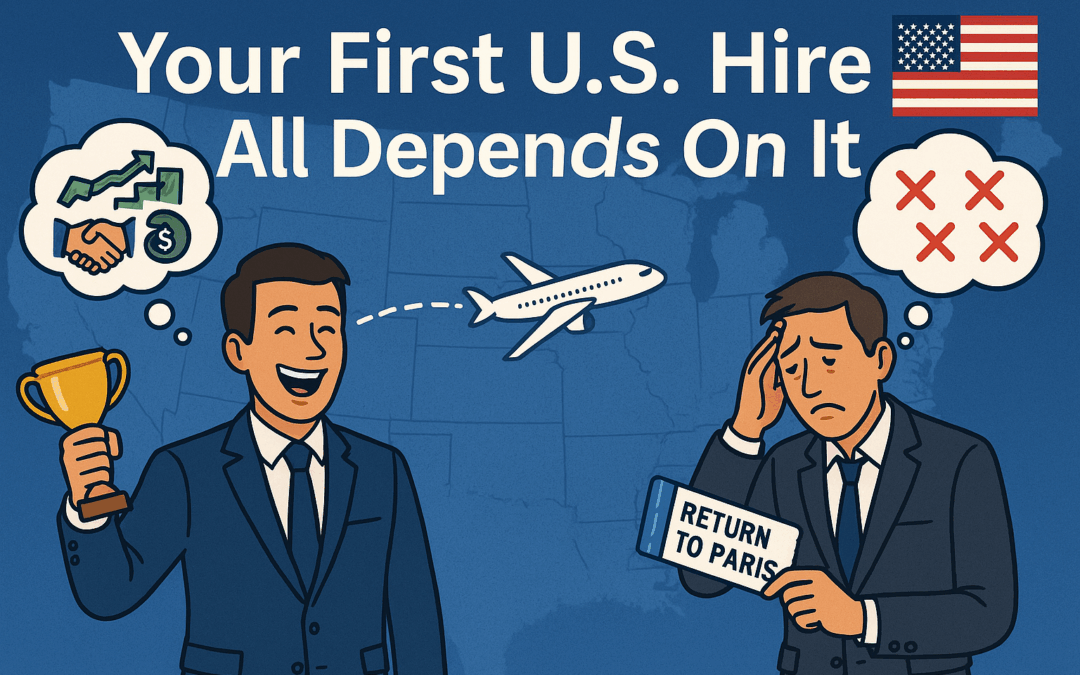
Your first U.S. hire will make or break your expansion.
I’ve seen this person accelerate a company’s growth faster than expected…
And I’ve also seen the wrong first hire set teams back six to twelve months.
So I wanted to share the lessons I’ve gathered from real cases, real conversations, and real outcomes — the things European companies are often not told before entering the U.S. market.
1.The U.S. Job Market Moves at a Different Speed
One of the first surprises for European companies is always the same:
“Why does everything go so fast here?”
Top candidates in the U.S. move quickly.
They expect:
- fast decision-making,
- clear communication,
- transparency about the role,
- and a hiring process that respects their time.
I’ve had clients in Europe lose excellent candidates simply because they waited one or two weeks between interviews. In the U.S., by the time you hesitate, the candidate already has another offer.
Your first hire needs to reflect that rhythm.
They can’t wait for approvals for every decision.
They must know how to keep momentum.
In the U.S., speed builds trust.
2.Your First Hire IS Your Brand
In Europe, your company already has history, reputation, and references.
In the U.S., none of that exists yet.
I remember a conversation with a candidate who told me:
“Before meeting the team, I had never even heard of the company. For me, the first person I met was the company.”
That stuck with me.
Your first hire becomes:
- your voice,
- your culture,
- your credibility,
- your reputation,
- and your story.
Clients, suppliers, partners, and future employees will form their opinion of your entire company based on this one individual.
It’s a lot of responsibility.
But when you choose well, it becomes a powerful advantage.
3.Adaptability Is More Important Than the Perfect Resume
One of the biggest misconceptions is:
“If we hire someone with the right skills, everything will work.”
Unfortunately, no.
Your first U.S. hire needs more than skills.
They need to be able to operate with very little structure.
I’ve seen profiles with impressive CVs struggle because they were used to:
- large teams,
- established processes,
- clear reporting lines,
- and full support functions.
In the U.S. launch phase, none of that exists.
Your first hire must be comfortable saying:
- “I’ll figure it out.”
- “Let me draft the process.”
- “I’ll speak directly with the customer.”
- “We don’t have this yet, but let’s create it.”
They need to be entrepreneurial, resourceful, and confident making decisions without a full corporate machine behind them.
In other words:
look for adaptability, not just achievements.
4.The Cultural Gap Is Real (And Often Underestimated)
Europe and the U.S. share many business values, but the way work is done is very different.
Here are a few things I’ve seen repeatedly:
- U.S. candidates expect clarity, directness, and quick feedback.
- Compensation expectations are often much higher than European headquarters anticipates.
- Americans value autonomy and trust — micromanagement kills motivation.
- Communication styles differ: “straightforward” in Europe can sound “blunt” in the U.S.
- Career growth needs to be visible, even in a small team.
When these differences aren’t recognized early, misunderstandings grow.
Your first hire must be able to navigate both cultures — representing the U.S. side to the European HQ and the European side to local employees or clients.
This “bridge” role is crucial and is often what determines whether the expansion stays on track.
5.The First Hire Shapes All Future Hires
Here is something many leaders don’t fully realize until it is too late:
Your first hire influences every other hire you will make in the U.S.
If the first person succeeds:
- they bring credibility
- they help you understand the market
- they contribute to building processes
- they help interview future hires
- they attract stronger candidates
- they build trust with HQ
If the first hire fails:
- growth slows down
- clients lose confidence
- turnover risks increase
- HQ becomes doubtful
- and you lose 6–12 months correcting course
This isn’t an exaggeration — I’ve seen it multiple times.
When the first hire is right, the U.S. expansion feels natural.
When the first hire is wrong, everything feels heavier.
6.The First Hire Is Not an Expense —It’s an Investment in Success
When companies plan their U.S. expansion, they spend time analyzing distributors, pricing, logistics, regulations, competitors… but sometimes give less attention to the first person who will actually bring all this to life.
Yet, this first hire is the one who will:
- speak to clients before you do,
- build your reputation,
- solve problems on the ground,
- communicate with HQ,
- attract future talent,
- and ultimately shape your U.S. success.
That’s why this hiring decision deserves time, attention, and the right process.
Your first hire is not just an employee.
They are the foundation of your entire U.S. journey.
7.Final Thoughts: This Is Why a Structured Hiring Process Matters
Given the weight of this first decision, the recruiting process cannot be improvised.
A few things I insist on with clients:
- Get complete alignment between the U.S. expectations and European leadership.
- Define the role very clearly — including what the first 90 days will look like.
- Benchmark compensation realistically (U.S. salary norms are different).
- Identify the non-negotiable skills AND non-negotiable soft skills.
- Keep the interview process short and efficient — the U.S. market won’t wait.
- Test adaptability, maturity, and communication style.
- Validate cultural fit on both sides.
The goal is not just to hire someone great.
It’s to hire someone who will succeed in your very specific context.
