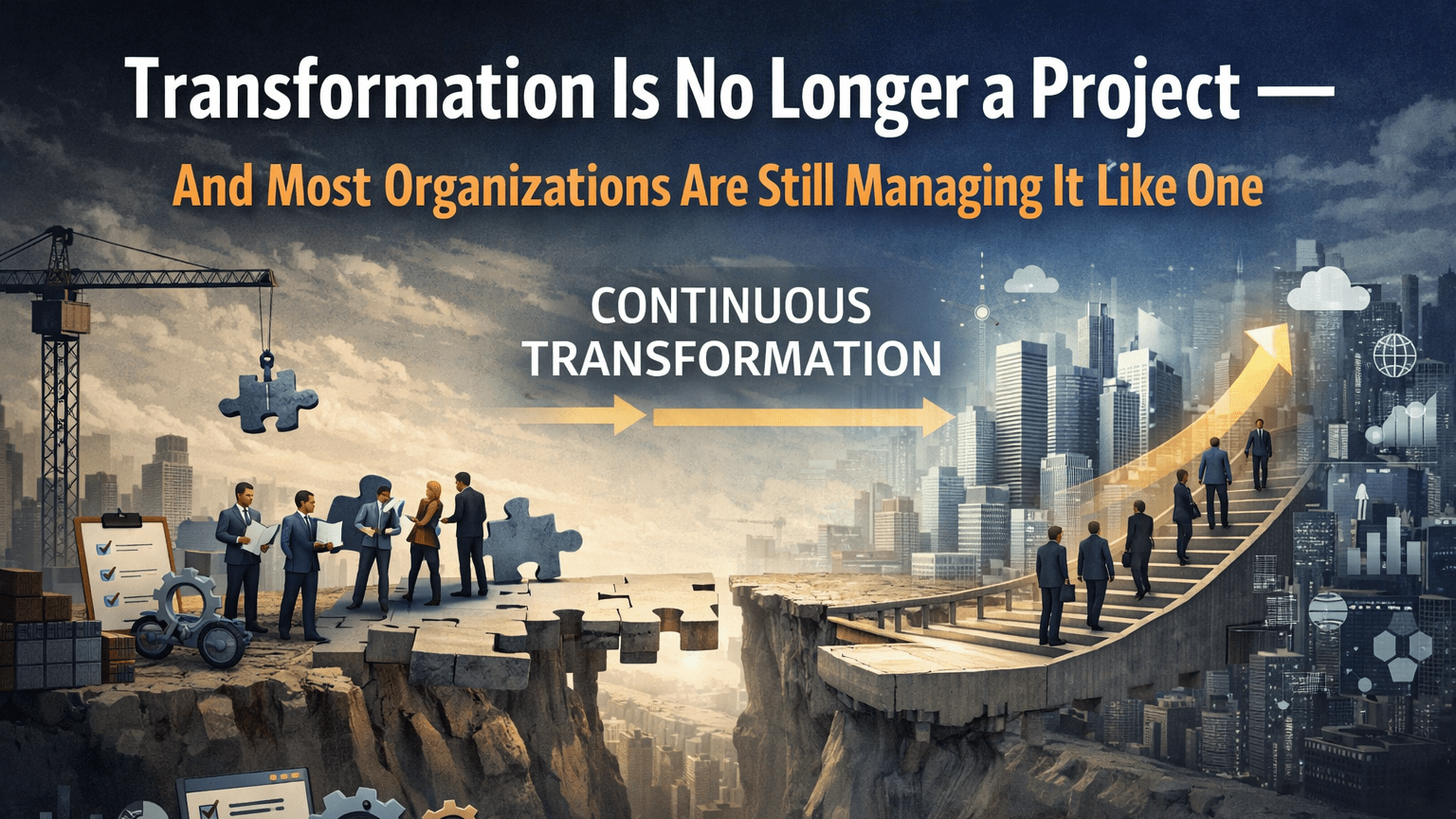
Transformation is a never-ending process, not a finite program. Organizations that still manage it episodically face structural burnout and governance failure. The fix requires classifying transformations and matching each to the right operating model.
Introduction
Most large organizations still treat transformation like a project: a defined scope, a steering committee, a deadline, and a celebration when it closes. But research drawing on thousands of senior executives is unambiguous — transformation is no longer something you complete. It is a permanent condition. And the gap between that reality and how most organizations are structured to respond to it is where programs quietly break down.
1. The Project Model Is Producing Diminishing Returns
The familiar playbook — restructure, delayer, appoint a program director, run a transformation office for 18 months — is hitting its limits. These structural productivity plays yield diminishing returns when the real upside lies in how work flows across the enterprise: cleaner decision rights, fewer handoffs, and genuine cross-functional alignment. Meanwhile, 87.5% of digital transformation initiatives fail, most often due to governance failures that surface after the initial design phase (ISACA). The problem is not ambition. It is the mismatch between an episodic management model and a challenge that never actually ends.
What I see consistently in practice is that organizations conflate very different types of transformation under a single program logic. A post-acquisition integration, a digital overhaul, and a cultural shift each demand a fundamentally different operating model, governance rhythm, and leadership posture. Treating them identically — because they all carry the label “transformation” — is one of the most expensive mistakes a COMEX can make. The first discipline is classification. Before asking how to run a transformation, ask what kind it is.
2. So What Does a Sustainable Transformation Infrastructure Actually Look Like?
Building organizational infrastructure for continuous change is not the same as running a permanent project. It means embedding the capacity to absorb, sequence, and sustain multiple concurrent transformations — without burning out the executives accountable for them. Research consistently shows that only 34% of organizations are truly reimagining their business (Deloitte, State of AI in the Enterprise 2026), while the rest remain at the surface. The gap is rarely strategic intent; it is absorption capacity and governance design.
Organizations that establish reinforcing systems — streamlined decision rights, aligned incentives, and continuous feedback loops — are significantly more likely to sustain transformation outcomes over time rather than regress to previous states. This is where partners like Penon Partners add structural value — not by taking over the program, but by helping the executive in charge build the internal infrastructure, the classification logic, and the governance model that makes continuous transformation manageable. For a deeper look at how this plays out in the French context, see where CAC 40 and mid-market companies actually stand on digital transformation in 2026.
Conclusion
The question facing transformation leaders today is not how to run a better program. It is how to build an organization capable of changing continuously — without treating every wave of change as a crisis. That requires distinguishing between transformation types, designing governance models that match each one, and investing in the people infrastructure that makes absorption possible. The executives who get this right will stop managing transformation. They will start leading it.
Your transformation deserves a governance model built for permanence, not a project plan with an end date.
Découvrir notre offre

