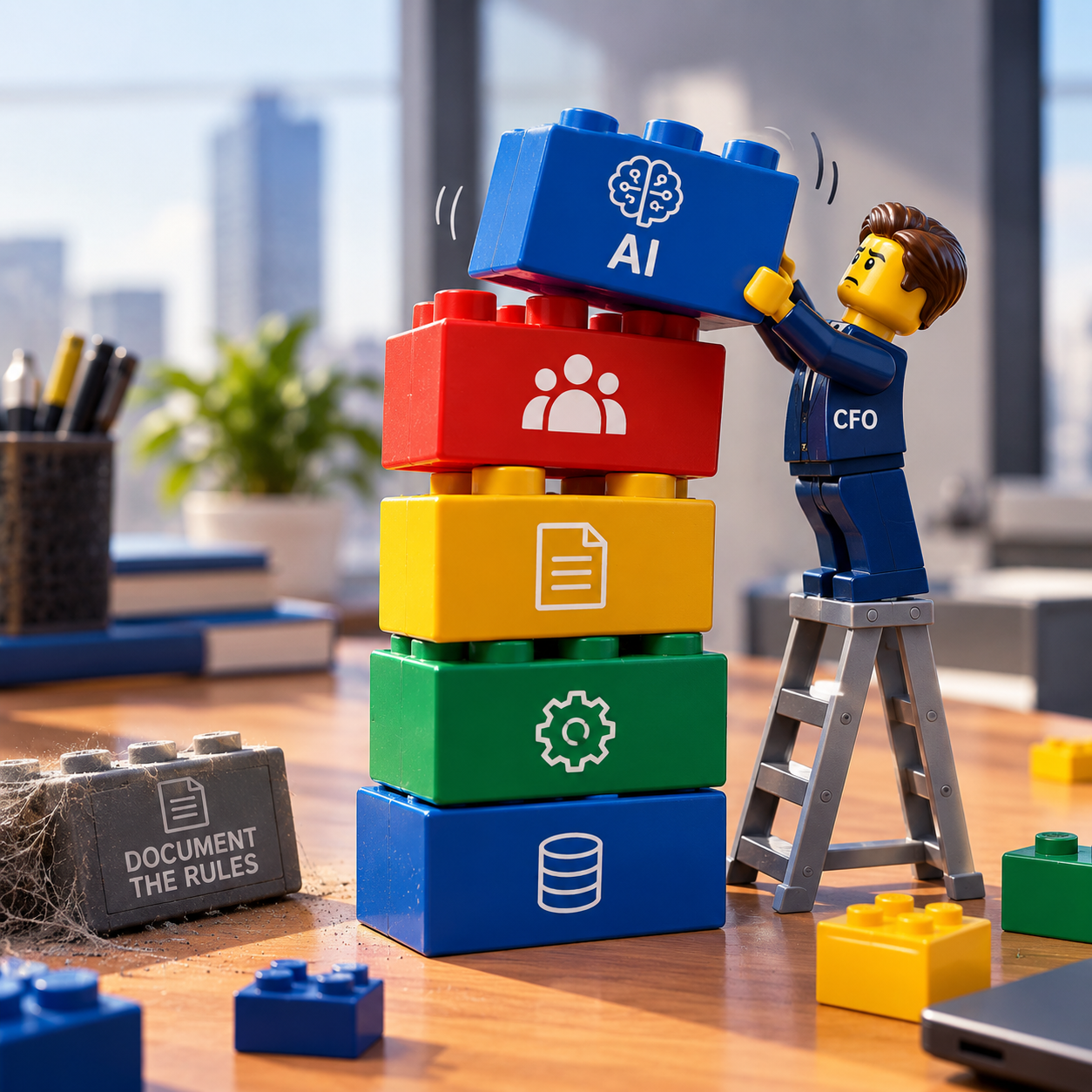
BCG confirms that 70% of AI transformation success depends on organization, people, and process, not the algorithm. Before asking where AI fits in Finance, CFOs must answer a more basic question: is our Finance function actually ready for it?
Introduction
As we move through 2026, one thing keeps coming back in conversations with Finance leaders: the People, Process, Technology framework is still the right one, even in the age of AI. BCG’s research published in May 2026 states it plainly. Around 70% of AI transformation success comes from organization, people, and skills, not from technology (BCG, 2026). Before asking “Where can we use AI?”, there is a more fundamental question to answer: “Is our Finance function ready for it?”
1. Why data readiness is still the starting point
The first project is still data. For AI to work in Finance, data must be consistent, connected, and structured across entities. The top two adoption barriers remain inadequate data quality and low data literacy, not the technology itself (Gartner, 2024). That gap between adoption and value is almost always a data and process gap.
But there is a second challenge that gets far less attention. AI needs to understand what the data means, not just access it. That means having clear definitions, analytical dimensions, calculation rules, business rules, sources of truth, ownership, and governance. In most Finance functions, these rules exist primarily in people’s heads. Experienced Finance professionals use their knowledge of the business to interpret the numbers. AI does not have that context.
2. What does building a Finance language for AI actually require?
If we want AI to analyze performance, explain variances, or build forecasts, we need to give it a common Finance language. This work is not exciting. But it is foundational, and it is where most organizations underinvest. Only 48% of organizations are actively improving data quality for AI deployment, and 45% are updating data governance frameworks (Deloitte, 2025). That means the majority are deploying AI on foundations that are not yet ready.
Concretely, this means aligning your chart of accounts across entities, defining intercompany reconciliation rules, documenting approval thresholds, and establishing clear data ownership. At Penon Partners, we consistently see Finance leaders underestimate this sequencing risk. Gartner projects that 90% of finance functions will deploy at least one AI-enabled solution by 2026 (Gartner, 2024). The question is not whether AI is coming. The question is whether the operational foundation is in place to make it work.
Conclusion
The CFOs who will extract real value from AI are not the ones who move fastest on technology. They are the ones who invest first in building a Finance function that AI can actually operate on: clean data, shared definitions, documented rules, and clear ownership. BCG’s framing is worth repeating: 70% of AI success depends on processes, data, and people (BCG, 2026). That is not an argument against AI. It is an argument for doing the foundational work first.
FAQ
Why does AI fail in finance functions that haven't fixed their processes?
AI fails in finance because it depends on clean, structured data and well-defined business rules. BCG’s 10-20-70 framework shows 70% of AI success depends on people and process. Without that foundation, AI automates dysfunction rather than eliminating it.
What is the difference between data quality and data readiness for AI in Finance?
Data quality means accurate, consistent records. Data readiness for AI also requires shared definitions, calculation rules, governance, and ownership, the Finance language AI needs to interpret numbers correctly. Most organizations invest in the first and overlook the second entirely.
What is the first step a CFO should take before any AI or automation investment?
Start by auditing your data governance: map your analytical dimensions, align your chart of accounts across entities, and document business rules. Gartner confirms data quality and literacy are the top AI adoption barriers in Finance. Fix those first, then layer in automation.
Your finance function needs the right foundation before AI can deliver real value.
Explore how we can help

